

- June 4, 2026
How LLMs and Computer Vision Are Transforming Object Recognition for Business
Artificial intelligence has evolved far beyond text processing. Today, modern LLMs combined with computer vision technologies make it possible to create solutions that recognize physical objects through a standard camera and help employees perform their tasks faster and more accurately.
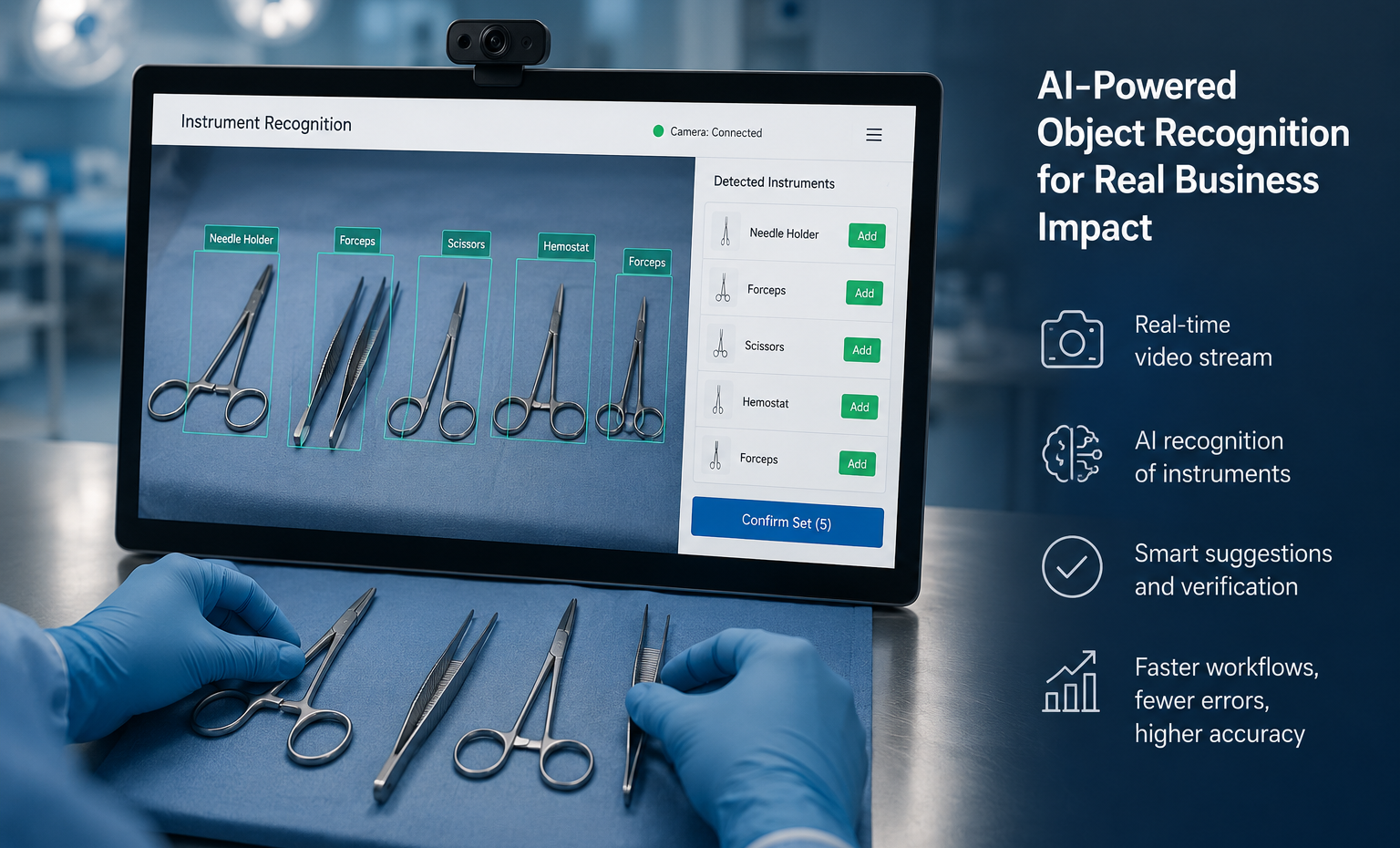
Recently, our team completed an interesting project for the healthcare industry. We developed a web-based application that works directly with a webcam video stream. Before a surgical procedure, a medical assistant places surgical instruments on a table — clamps, forceps, scissors, and other tools required for the operation. The system analyzes the video feed in real time, identifies each instrument, and suggests adding it to the surgical kit inventory.
What made this project particularly interesting was that success depended on much more than training an accurate recognition model. In real-world environments, AI solutions must balance technical performance with usability.
On the machine learning side, the challenge was achieving reliable recognition under varying conditions. The model needed to handle different viewing angles, lighting conditions, partial object occlusions, and visually similar surgical instruments. To achieve a high level of accuracy, we prepared and trained the model using a specialized dataset tailored to the client’s requirements.
Equally important was the user experience. Even the most advanced AI model provides little value if the interface slows down the workflow. We therefore invested significant effort into designing an intuitive web interface where operators can view the live camera feed, receive AI-powered suggestions, and quickly confirm or adjust the contents of the surgical kit.
Projects like this demonstrate how AI-powered object recognition can create tangible business value. By automating inventory verification, object identification, and operational workflows, organizations can reduce human error, improve efficiency, and increase process transparency. Thanks to modern web technologies, these solutions can often be deployed directly through a browser, requiring nothing more than a camera and an internet connection.
This project is a great example of how the combination of artificial intelligence, computer vision, and thoughtful user experience design can solve real-world business challenges and deliver measurable results.